
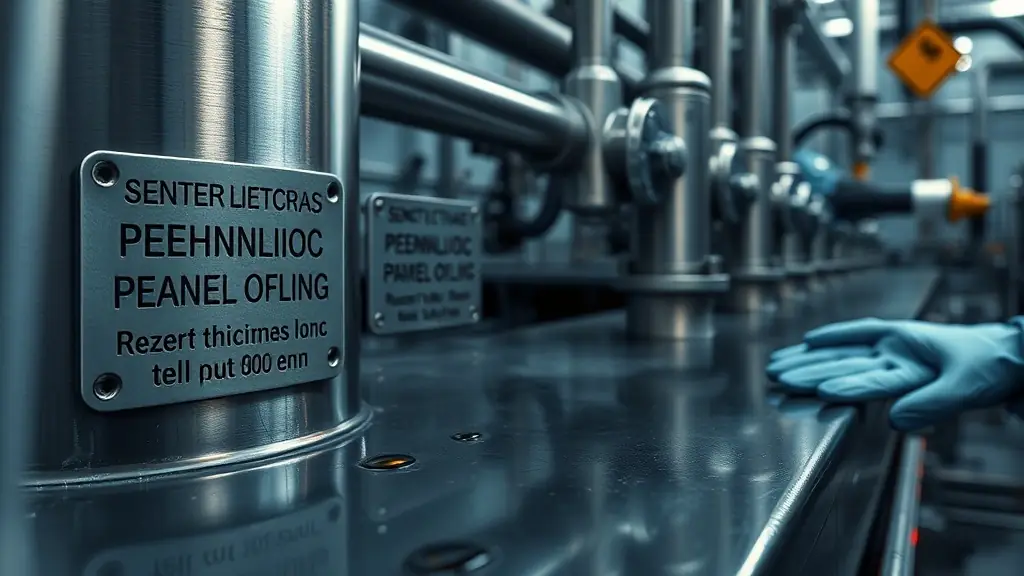
Ask five people in a plant what phenolic label chemical resistance actually means and you will get five different answers, because resistant covers a wide range depending on the chemical, the concentration, the temperature, and how long the exposure lasts. This guide gives you the general picture from an engraving shop's perspective: what engraved phenolic shrugs off day to day, where it can struggle, and what to tell us so we spec the right stock instead of the cheapest one.
One thing up front: we are not going to hand you a numeric resistance chart with exposure times and percentage ratings, because that data depends on the specific resin formulation, concentration, temperature, and duration, and a generic chart would give you false confidence. What we can tell you, from engraving and shipping this material for years, is how it actually behaves in the field and how to think about specifying it correctly.
Specify the actual chemical exposure
For equipment and valve tags exposed to cleaners or process chemicals, provide the chemical names, concentrations, temperatures, contact duration, and cleaning method. Engraving cuts the characters into the surface, but it does not establish a chemical rating for the plastic, backing, or adhesive. Review the applicable manufacturer documentation for the selected grade before approving the material and mounting.
Where to be careful
Resistance is not unlimited, and a few conditions are worth flagging before you order:
- Strong ketones, acetone being the common one, can attack the cap layer on some standard acrylic-capped stock over repeated or prolonged contact. If your process involves regular acetone exposure, tell us and we will spec a chemical-rated stock built for it instead of assuming standard laminate will hold.
- Continuous heat above the material's rated temperature can soften standard laminate over time, even if a brief exposure would be fine. If a label sits near a furnace, exhaust, or continuous high-temperature process, give us the actual operating temperature so we can spec accordingly rather than guess.
- Constant direct sunlight over years can cause the cap color on standard stock to chalk or dull, which is a UV effect, not a chemical one, but it shows up the same way as a durability complaint. Outdoor and rooftop installations should generally use a UV-stable stock from the start.
- Abrasive contact, foot traffic, dragging chains, or repeated scraping, can eventually wear a shallow engraving line, though this is a mechanical wear issue rather than chemical attack, and it is rare in normal wall or panel mounting.
Compare durability for the actual installation
For facility asset labeling, durability depends on the selected stock, attachment, and actual exposure. Inspect the identification and its mounting during maintenance, and replace labels that are unreadable or damaged. The trade name phenolic does not establish a service life or prove that one construction will outlast every printed alternative.
How to spec a label for a harsh environment
The single most useful thing you can do when ordering is describe the actual environment instead of just asking for the good stuff. Tell us:
- Indoor or outdoor, and if outdoor, how much direct sun exposure.
- Whether the area gets washdown, and with what, water only, degreaser, caustic cleaner.
- Specific chemicals the label will contact regularly, not just occasionally.
- Operating or ambient temperature range near the mounting location.
- Whether the label will see physical abrasion, foot traffic, or contact with moving parts.
Modern acrylic engraving laminate is often sold under the industry name phenolic. True resin-based phenolic is a different material family. Compare phenolic and acrylic using the actual manufacturer grade and its heat, chemical, and outdoor-use documentation rather than the trade name alone. Our color and ply guide explains the cap-and-core choices; confirm the selected combination against your project requirements before ordering.
What we do with harsh-environment orders
When you flag a job as chemical, high-heat, or long-term outdoor exposure, we route it to the appropriate stock before engraving rather than defaulting to standard laminate and hoping. It costs the same to ask the question up front as it does to find out months into service that the wrong material was used, except one of those options means reordering and remounting.
Common questions
Will bleach or common disinfectants damage a phenolic label?
Standard phenolic generally tolerates routine cleaning with common disinfectants and diluted bleach solutions used for surface cleaning. If your facility uses disinfectants at industrial strength or with extended contact time, mention that when ordering so we can confirm the stock is appropriate.
Is phenolic waterproof?
Yes, standard phenolic laminate is not affected by water contact or humidity, which is part of why it is the default for washdown areas, mechanical rooms, and outdoor equipment.
What happens if I do not know the exact chemicals a label will contact?
Tell us the general category, cleaning chemicals, fuels, coolant, industrial solvents, and we will spec conservatively. It is better to describe the environment broadly than to guess a specific product name incorrectly.
Can an existing label be upgraded to a more resistant material?
Yes. If labels installed years ago are showing wear from an environment they were not originally specified for, send us a sample or a description of the conditions and we can reorder in a stock built for it.
Does a thicker label resist chemicals better?
Ply thickness affects rigidity and mounting more than chemical resistance, which is mostly a function of the resin and cap material. Tell us the environment and we will recommend both the right stock and the right thickness for how the label will be mounted.
Confirm substrate and exposure requirements against our material specifications and manufacturer references before ordering.