
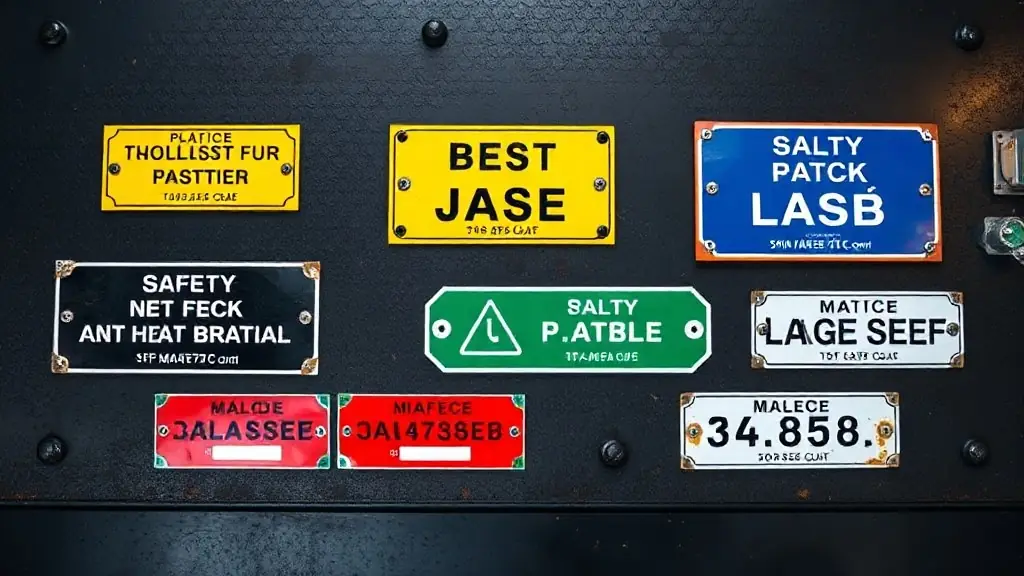
Industrial label color codes aren't decoration. On a factory floor or in a mechanical room, color is often the first thing a worker registers, before they've read a single word, and the color conventions that show up across danger tags, pipe markers, and equipment ID exist so that a glance tells someone roughly what they're looking at before they get close enough to read the text. Getting the color combination right on an engraved label isn't a style choice. It's part of the label doing its job.
We engrave to these conventions daily, and the questions we get most are about which color goes where, and how that translates onto two-ply or three-ply phenolic and acrylic stock. Here's the practical version.
ANSI safety colors: danger, warning, caution
The ANSI Z535 series is the reference most facilities and safety managers work from for the meaning of safety colors and signal words, and the conventions from that world carry over directly onto engraved tags and nameplates.
- Red signals danger, an immediate hazard that will cause serious injury or death if not avoided. White-on-red is the standard combination for danger and emergency-stop identification.
- Orange signals warning, a hazard that could cause serious injury if not avoided.
- Yellow signals caution, a hazard that could cause minor to moderate injury, and is also the general color for physical hazard marking. Black-on-yellow is the combination most people recognize instinctively.
- Blue signals notice or a mandatory action, information that's important but not a hazard warning in itself. White-on-blue is standard here.
- Green marks safety equipment and information, first aid stations, safety showers, and egress routes. White-on-green is typical.
Signal words matter as much as color. A label that says DANGER without the red background, or a yellow label that should say WARNING but says CAUTION, undercuts the whole point of a standardized system. When you spec a label, give us both the color and the word, and we'll match the combination rather than guessing from one or the other.
ASME A13.1 and pipe marking
Where color coding gets genuinely detailed is pipe and process marking. ASME A13.1 defines the color scheme used to identify the contents of a pipe at a glance, fire-protection piping, toxic or corrosive materials, and flammable materials each get their own defined color combination, with additional colors covering water, compressed air, and other common process fluids. If your facility runs a pipe-marking program, the color on the phenolic or plastic pipe marker isn't a preference, it's the identifier a worker relies on before they open a valve or start work on a line. We build valve and pipe tags to that convention when you tell us the media each line carries; our valve tag standards reference covers the sizing and format that goes with the color.
Electrical identification conventions
Electrical equipment ID doesn't follow one universal color rule the way pipe marking does, but common practice on job sites leans on high-contrast combinations, white-on-black or black-on-white for general circuit and equipment identification, with red reserved for danger and emergency marking so it isn't diluted by using it for routine ID. Consistency across a facility matters more here than any single correct answer: pick a convention for equipment ID versus hazard marking and hold every label in the building to it.
How this maps onto two-ply engraved stock
Multi-layer engraving laminates use a colored cap over a contrasting core, so engraving exposes the core color as the text. That construction does not make the substrate or its color layers immune to weather, chemicals, abrasion, or heat. Use our color chart to specify the background and engraved-text colors, then confirm the selected stock for the actual exposure and project requirements.
Specifying color codes across a mixed order
The most common mistake we see isn't picking the wrong color, it's inconsistency across a large order, one batch of danger tags in white-on-red and another batch from a different supplier or a different year in a slightly different red. If you're standardizing an existing facility's asset labeling, send us a sample of the existing label or the safety standard you're working from, and we'll match the combination across the whole order rather than defaulting to our closest stock color. The same applies to pushbutton and legend plates, where the color of a stop button legend needs to match red danger conventions even though the plate itself is small.
Common questions
Is there one single standard that covers all label colors?
No single standard covers every situation. ANSI Z535 governs general safety signal colors, ASME A13.1 governs pipe marking specifically, and many industries and individual facilities layer their own internal standard on top. When in doubt, tell us which standard your facility follows, or send a sample, and we'll match it.
Can I mix cap colors on the same order?
Yes. Most orders we run include several color combinations, danger tags, caution tags, and equipment ID plates all in one batch. Just specify the combination per line item or per label type on your order.
Does a specific shade of red always mean danger?
The signal word and the general red-orange-yellow hierarchy matter more than one exact shade. What matters most for consistency is that every danger label in your facility uses the same red, which is why we recommend standardizing to one stock color rather than mixing suppliers over time.
What about custom colors outside the standard set?
We can source custom cap and core combinations for branding or specific internal standards. For anything safety-related, though, we'd recommend sticking to the recognized ANSI conventions so the label reads correctly to anyone unfamiliar with a facility's internal system.
Tell us the standard you're working to, or send a sample label, and we'll engrave your whole order to one consistent color code. See our phenolic tags for the formats we produce most often for safety and identification marking.
Check the applicable edition and scope in ASME A13.1 piping identification resources.
Confirm substrate and exposure requirements against our material specifications and manufacturer references before ordering.