
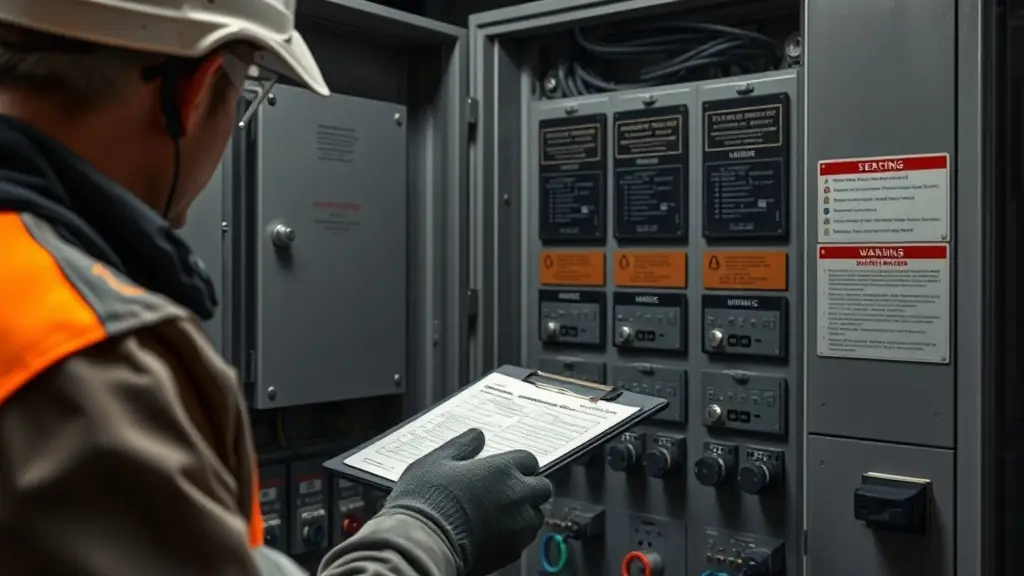
NEC labeling requirements are one of the most common reasons an otherwise correct electrical installation gets flagged at inspection. The wiring is right, the terminations are torqued, and the panel is full of good work, but a disconnect has no label, a directory says spare over a live breaker, or an arc-flash warning is missing. This guide organizes the field-marking rules electrical contractors run into most often, in plain language, so you can label a job to pass the first time.
One note before the checklist: the National Electrical Code sets the baseline, but the authority having jurisdiction and the specific code edition your state or municipality has adopted govern what is actually enforced on your job. Article numbers and requirements can shift slightly between code cycles, and local amendments are common. Treat this as a working checklist, not a substitute for confirming the adopted edition with your inspector.
What inspectors check, article by article
Disconnecting means
NEC 110.22 requires each disconnecting means to be legibly marked to identify its purpose, unless the purpose is evident. That means a disconnect at a rooftop unit, a motor, or a piece of process equipment needs a label that says what it disconnects, not just a blank handle. Where disconnects are grouped, each one needs its own identification so a technician does not have to guess or trace conduit to find the right switch.
Available fault current
NEC 110.24 requires service equipment in other than dwelling units to be legibly marked with the available fault current and the date that calculation was performed. If equipment is later modified in a way that affects the available fault current, the marking has to be updated. This is a field-marking requirement inspectors check specifically, and it is one that gets missed on retrofit and service upgrade work where the original label never gets updated to match.
Arc-flash warning
NEC 110.16 requires equipment such as switchboards, panelboards, and industrial control panels that are likely to require examination, adjustment, servicing, or maintenance while energized to be field marked with an arc-flash hazard warning. The rule covers the presence of the warning label; the specific incident energy or PPE category shown on it comes from a separate arc-flash study, not from the Code section itself. Our comparison of arc-flash warning labels and permanent equipment ID covers how the two label types differ and why a facility usually needs both.
Series-rated systems
Where equipment is protected by a series combination rating rather than fully rated devices, NEC 110.22(B) requires the equipment to be field marked to indicate that it has been applied with a series combination rating. This is another marking that is easy to omit on a panel schedule redo, because the rating is a design decision made upstream, not something the crew doing the labeling necessarily sees on the equipment itself.
Circuit directories
NEC 408.4 requires a circuit directory or circuit identification for every panelboard, clearly identifying the purpose or use of each circuit. The directory has to be legible and located on the face or inside the door of the panel. In practice, inspectors also look for directories that match what is actually installed, no unmarked spares that turn out to be live circuits, and no crossed-out handwritten notes standing in for a real label. If you are labeling a panel from scratch or updating one after a remodel, our guide to building an NEC-compliant panel schedule walks through structuring the directory itself before it ever gets engraved.
Why engraved labels satisfy the intent of these rules
Most of these Code sections use language like legibly marked and expect the marking to remain accurate and readable for the life of the equipment. A handwritten note in permanent marker, a paper label under tape, or a printed sticker technically satisfies the letter of marked on the day of inspection, but none of them hold up the way the intent of the rule assumes. Handwriting fades and gets illegible. Paper labels curl, get wet, or fall off inside a panel that runs warm. Adhesive stickers lift at the corners within a year or two in a mechanical room.
Engraved phenolic does not have that failure mode. The text is cut into the material, so there is no ink to fade and no separate layer to peel. The standard warning color combinations, white text on red for danger, black on yellow for caution, black on white for general identification, map directly to the conventions inspectors are trained to look for, which makes the label read correctly at a glance instead of needing to be puzzled out. For a broader walkthrough of how these pieces fit together across a whole facility, see our NEC compliance guide for equipment labeling.
Getting the wording right the first time
The other common failure mode is not a missing label, it is a wrong one: a directory that does not match the as-built panel, or a disconnect label that describes equipment replaced years ago. The fastest way to avoid a re-inspection over wording is to send us your panel schedule, one-line diagram, or equipment list and let us engrave directly from your data. That removes the transcription step where a number gets mistyped or a load description gets abbreviated differently than what is on the drawing.
We work with custom engraved phenolic labels for the full range of what shows up on this checklist: disconnect ID, fault current markings, series-rating labels, and panel directories, sized and worded to match your documentation.
Common questions
Does the NEC require labels to be a specific color?
The Code generally requires markings to be legible and, for hazard warnings, to indicate the nature of the hazard, but the specific color scheme comes from established safety-marking conventions rather than a single NEC color mandate. We default to the conventional combinations, white on red for danger, black on yellow for caution, unless your spec calls for something else.
Who decides which code edition applies to my job?
Your local authority having jurisdiction. States and municipalities adopt NEC editions on their own schedule, sometimes with local amendments, so the same article number can carry a slightly different requirement depending on where the job is. Confirm the adopted edition with your inspector before finalizing label wording on an unusual case.
Do I need an arc-flash study before I can order labels?
For labels showing incident energy or PPE category, yes, that data comes from a study. For the general disconnect ID, directory, and fault current markings covered above, we can engrave straight from your panel schedule or one-line without waiting on a study.
Can you relabel an entire facility at once?
Yes. Send us the panel schedules or a walk list and we will engrave the full set as a batch, which keeps color, font, and format consistent across every panel instead of a mix of styles accumulated over years of one-off replacements.
Confirm the adopted code and project requirements using NFPA National Electrical Code resources and your authority having jurisdiction.
Confirm substrate and exposure requirements against our material specifications and manufacturer references before ordering.