
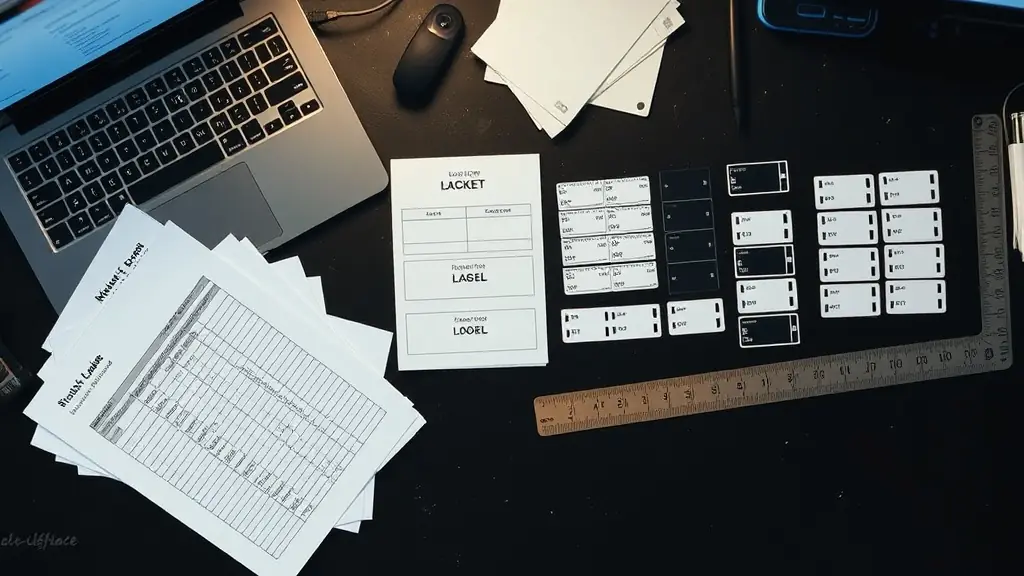
When you need to bulk order phenolic tags, hundreds or thousands of pieces, sequential valve numbers, a full asset-tagging list, or a panel's entire circuit directory, the single biggest factor in getting an accurate, fast quote isn't the material or the color. It's how the list arrives. A well-formatted spreadsheet lets us engrave straight from your data. A loose list typed into an email body has to be re-keyed by hand on our end, and every retype is a chance for a transposed number or a misread abbreviation to end up permanently engraved on a plate you now have to reorder.
This is the layout we ask for, and why each piece of it matters once your order is on the shop floor rather than in a quote request.
Why a structured file beats a list in an email
A paragraph of tag text pasted into an email reads fine to a person, but it isn't structured data. Someone on our end has to parse it into rows, decide where one tag's text ends and the next begins, and guess at anything ambiguous, a line break that might mean two lines on one tag or two separate tags. A spreadsheet with one row per label removes every one of those guesses. It's also the format that lets us quote accurately the first time, since quantity, size, and any per-line variations are already broken out instead of buried in prose.
A layout that works
Send us Excel (.xlsx) or CSV with one row per label. The columns that matter most:
- Line 1 text and Line 2 text (add more columns if any tags need a third or fourth line).
- Quantity for that exact label, since a bulk order is rarely one quantity across every line item.
- Size, or a single note at the top of the sheet if every label in the order shares one size.
- Color combination (for example black on white, or white on red for danger tags), especially important if your order mixes conventions across label types.
- Mounting, adhesive, drilled holes, or slotted for a chain or wire tie, since different mounting methods can mean different hole placement on the same size plate.
If every label in the order is the same size, color, and mounting style, one note at the top of the file covers all of that and you only need to fill in text and quantity per row. The goal is a file where nothing about how to produce a given tag is left for us to infer.
Pulling the list straight from your schedule
The cleanest bulk orders we receive don't start as a fresh spreadsheet built for us, they're pulled directly from a source document that already exists: a panel schedule, a valve list, an asset register, or a CAD export from the design software. If your tag text needs to match a schedule or drawing exactly, working from that same source file rather than retyping it into a new sheet removes an entire category of mismatch between what's on the drawing and what's engraved on the plate. Our guide to ordering from a panel schedule walks through how we map schedule columns directly to label lines for electrical work specifically, and the same logic applies to valve lists and asset registers.
Sequential numbering, without typing every number
Need tags numbered 1 through 500, or valve tags V-101 through V-140? You don't need to type every value into the spreadsheet. Give us the starting value, the ending value, and the format (leading zeros, a prefix or suffix, letter-number combinations), and we generate the full sequence on our end. This is also where a structured file pays off twice: if part of your order is sequential and part is a list of specific, non-sequential tag text, both can live in the same file as long as the sequential range is called out clearly.
Sorting and kitting for field installation
For large orders headed to a job site rather than a desk, how the finished tags are sorted when they ship matters as much as how they're engraved. Tell us if you need tags grouped and bagged by panel, by floor, by system, or in the install sequence a crew will actually walk. We can kit a bulk order so the field crew opens one bag per panel or per zone instead of sorting hundreds of loose tags on-site to find the dozen that belong to the unit in front of them. This is worth specifying up front, since it costs nothing extra to organize an order correctly the first time and saves real labor in the field.
File formats we accept
Excel (.xlsx) and CSV cover the vast majority of orders and are the easiest for us to work from directly. We can also work from a PDF schedule or CAD export when that's the only source you have, though a native spreadsheet or a direct export to one is faster to quote and less prone to a transcription step on our end. If you're not sure your file is in a workable shape, send it anyway. We'll tell you if anything needs restructuring before production starts, not after.
Common questions
What if my list has some sequential tags and some custom text mixed together?
That's normal for a lot of orders. Put the sequential range in its own clearly labeled block or note, and list the custom-text rows individually. We'll separate them in production and you'll still get one combined quote and one shipment.
Do you proof large orders before engraving?
Yes. For any bulk order, we send a proof of the full list before anything goes into production, so you're reviewing exact text and quantities against your source document rather than trusting a re-key.
How do I handle duplicate or near-duplicate tag text?
List it exactly as you want it engraved, even if two rows look nearly identical, since small wording differences are usually intentional in a schedule, a spare breaker versus a labeled circuit, for example. If something looks like it might be a duplicate in error, we'll flag it on the proof rather than silently correcting it.
Is there a minimum order size for bulk pricing?
Bulk orders range widely, from a few dozen tags for a small panel to thousands for a full facility retrofit. Send your list and we'll quote it as what it is rather than requiring a specific minimum to qualify.
Send your spreadsheet, schedule, or CAD export and we'll turn it into an accurate quote with no manual retyping in between. See our bulk ordering page for the file types and process, or explore our full range of phenolic tags before you build your list. Ready to get pricing on your list? Request a quote and attach your file, sequential range, or schedule and we'll take it from there.
Confirm substrate and exposure requirements against our material specifications and manufacturer references before ordering.
Download the label ordering template
CSV label schedule · Excel label schedule (ZIP)
Keep one row per distinct label design and use the quantity column for repeats. Unzip the Excel file to access instructions, a blank order sheet, and clearly marked examples. Replace example wording with your approved project data, preserve leading zeros, and confirm the source revision before uploading.
Send the completed schedule for custom phenolic tag pricing or specify the material and attachment for lamacoid tag production.