
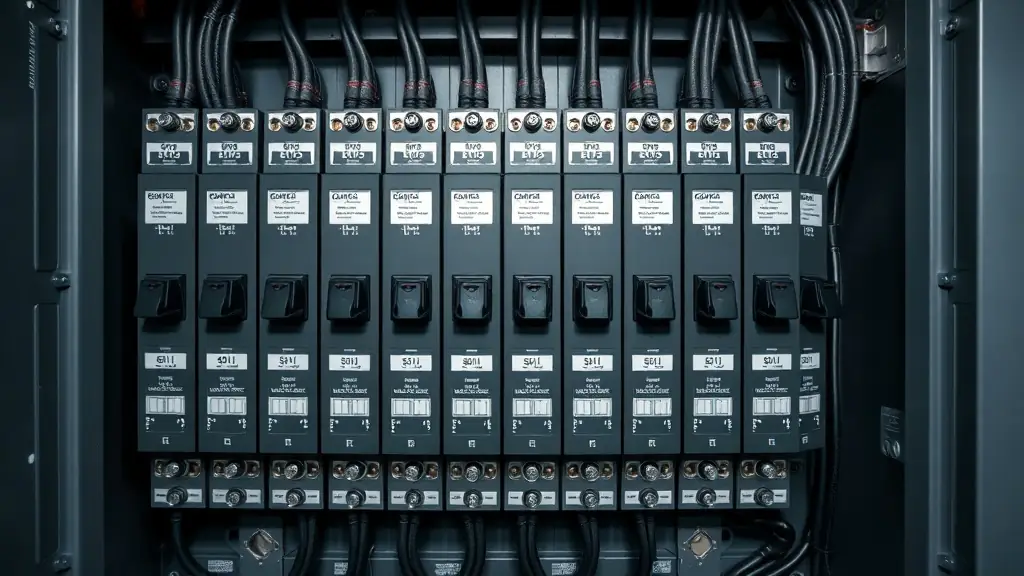
Electrical panel labeling is one of those tasks that looks simple until you're standing in front of a lineup of gear with the inspector, and the placard that's worded correctly turns out to be mounted somewhere they have to go looking for it. Where a label goes is as much a part of the job as what it says. Here's where engraved labels belong on the panels, disconnects, and switchgear we engrave for most often, and why placement is what actually gets a job through inspection cleanly.
A rule of thumb we give contractors: a label needs to be readable at the distance someone will actually be standing when they need the information, without opening a door they shouldn't open first. That single idea drives most of the placement decisions below.
Panelboards
The main panel identification label goes where it's visible without opening the panel, typically on the outside of the door or the enclosure face, so anyone walking a facility can identify the panel without touching it. The circuit directory, the card or schedule listing what each breaker feeds, mounts inside the door where it's protected from wear but visible the moment the door opens. Keep the directory label square, level, and sized to match the directory pocket or holder so it doesn't shift or curl. If the panel has a separate deadfront, some jurisdictions and specs also call for the panel ID repeated there; check your one-line and the AHJ's expectations before finalizing the set.
Disconnect and feeder identification
A disconnect needs to say, at a glance, what it disconnects. That label mounts on the enclosure face, near the operating handle, not on a side or back panel someone has to walk around to read. For feeder and voltage identification, include the voltage and, where the equipment may be examined or worked on while energized, the arc-flash and shock-hazard warning marking in the same visible location. The goal is that someone standing in front of the equipment with the door closed already knows what it is, what it carries, and whether it's safe to approach.
Switchgear and distribution lineups
- Label each section and each device to match the panel schedule and one-line exactly, not a shorthand version that only makes sense to whoever wrote it.
- Keep every plate in a lineup the same size, font, and mounting height so the whole run reads as one system, not a patchwork of labels added over different projects.
- Number or letter sections left to right or top to bottom consistently with how the drawings number them, so a technician can trace a device from the one-line to the physical gear without translating.
Formatting the schedule so labels match the drawings
Most placement problems trace back to a labeling order that didn't match the panel schedule in the first place. If your circuit directory text is typed fresh at the panel instead of pulled from the approved schedule, small differences creep in, a load description abbreviated differently, a spare marked live, a circuit number transposed. We engrave directly from the schedule or one-line you send us, so the wording on the plate matches the wording an inspector or the next electrician will be checking it against. Send the file rather than a paraphrase and that whole category of error goes away.
Mounting hardware by surface
Placement and mounting hardware go together. Adhesive-backed plates work well on clean, flat, painted metal, but they're the wrong choice on textured, vented, or bare unpainted enclosures where the bond won't hold long-term. On those surfaces, or anywhere the label needs to survive years of vibration, washdown, or temperature cycling, we recommend mechanical mounting, screws or standoffs through pre-drilled holes. Tell us the enclosure surface when you order and we'll spec the plate's mounting style to match rather than defaulting to adhesive for everything.
What inspectors are actually checking
Beyond wording, inspectors are checking that a label is legible, permanent, and located where it does its job, identifying equipment, warning of a hazard, or directing someone to the right disconnect, without extra steps. A label with the right words in the wrong place, buried behind a hinge or facing the wall, doesn't satisfy that intent any better than a missing label does. The adopted code edition and the local AHJ govern the specifics for a given jurisdiction, so treat this guide as the placement logic that generally holds true, and confirm project-specific requirements with your inspector or engineer of record.
Consistency across a whole job
When every panel, disconnect, and section in a facility uses the same label material, size, and typography, the whole installation reads as more professional and inspects faster because nothing looks improvised. That's true whether it's a single panel or a full switchgear lineup. We engrave whole label sets, from pushbutton legend plates to full panel directories, to one standard so the finished job looks like it came from one plan, not several trips to different suppliers. It's also worth building the plan around one material family from the start; our engraved phenolic labels cover panel ID, circuit directories, and disconnect marking with the same durable, non-conductive stock.
Common questions
Does the circuit directory need to be engraved, or is a typed card acceptable?
Many jurisdictions accept a typed directory card as long as it's legible and complete. Engraved directories are more durable and won't smudge, fade, or fall out of the holder over years of servicing, which is why many contractors standardize on engraved for panels that see frequent access.
Where does the arc-flash label go if the disconnect label already covers that spot?
Both can co-exist on the enclosure face; the priority is that each is fully visible and not overlapping. If space is tight, talk to us about combining information onto a single larger plate rather than stacking two small ones.
Do all panels in a facility need to match, or just new work?
Code compliance applies to what's required at each panel, not to matching older labels. That said, most facility managers we work with use a retrofit or renovation as the opportunity to bring the rest of the building's electrical labeling up to one consistent standard while the crew is already on site.
Send us your panel schedule or one-line and we'll lay out the full label set, wording and placement both, before anything goes into production. See our phenolic panel and placard engraving for sizing and formats.
Confirm substrate and exposure requirements against our material specifications and manufacturer references before ordering.