
How to Mount Engraved Labels So They Last
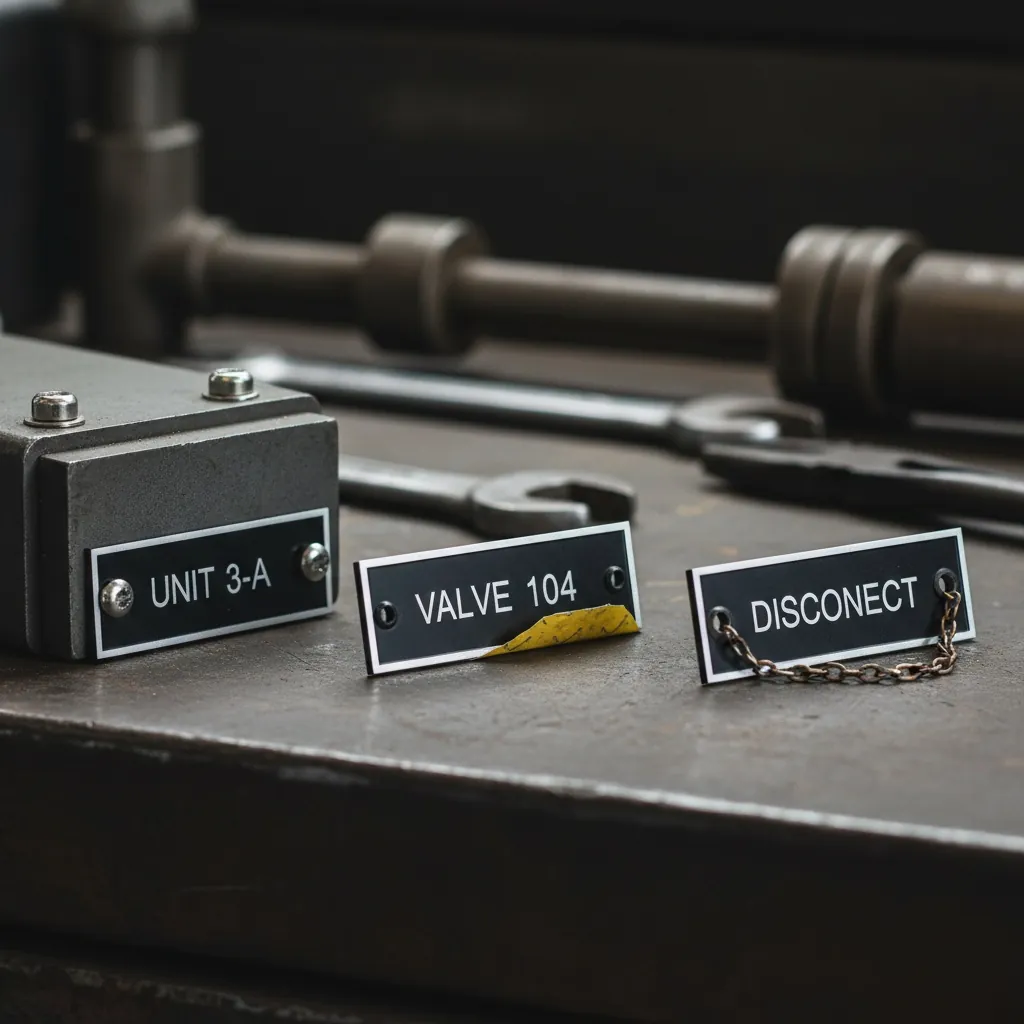
A perfectly engraved label is only as good as how it's attached. The wrong mount fails in the wrong environment — adhesive that lets go in heat, a screw hole in the wrong spot, a tag that walks off a valve. Here's how to choose adhesive, mechanical, or chain mounting by surface and application.
Adhesive backing
Pressure-sensitive adhesive suits flat, clean, accessible surfaces — panel faces, enclosure doors, equipment housings. It's the fastest to apply and leaves no holes. Success depends on surface prep (clean and dry) and on matching the adhesive to the environment; heat, oil, and texture all reduce adhesion, so adhesive is best where the surface is smooth and conditions are moderate.
Adhesive-backed engraved labels work especially well on clean painted electrical panels, indoor control cabinets, finished metal enclosures, and light-duty equipment ID where drilling is unnecessary or undesirable. They are efficient for panel directories, breaker identification, small disconnect labels, and large label sets that need fast field installation. The limitation is the surface: rough cast metal, powder-coated texture, oily machinery, oxidized aluminum, low-energy fiberglass, sun-heated outdoor boxes, and repeated solvent cleaning can all shorten bond life. If any of those conditions apply, adhesive should not be the default.
Screw and rivet holes
For permanence, vibration, high heat, outdoor exposure, or any surface adhesive won't hold, pre-drilled holes for screws or rivets are the durable answer. Specify hole count, size, and position (typically corners or a top/bottom pair) so the label mounts flat and stays put through mechanical stress. This is the standard for equipment nameplates and anything expected to last the life of the gear.
Mechanical fastening is the safer choice when the label identifies a disconnect, switchgear section, transformer, rooftop unit, valve station, or fixed industrial asset that will be inspected and maintained for years. Screws and rivets create a positive attachment that does not depend on adhesive bond strength. For replacement plates, send the existing hole pattern, finished size, and a photo with measurements so the new engraved label matches the old mounting points instead of creating extra field drilling.
Chain and fasteners
For items that aren't flat or where the tag must hang — valves, cable runs, removable equipment — a hole drilled for beaded chain, jack chain, or a cable tie lets the tag attach to the body without adhesive or screws. This is the norm for valve tags, which attach to the valve body rather than the handle.
For hanging tags, the important details are hole size, material thickness, attachment hardware, and where the tag will live. A valve tag in a mechanical room, an outdoor valve pit, a cable tray marker, and a conduit tag may all need different hole placement or hardware. Tell us whether the tag will hang from a valve handwheel, pipe, cable tray, conduit run, or equipment frame, and whether stainless wire, bead chain, S-hooks, or cable ties will be used.
What to send with the order
Include mounting details with the label list instead of leaving them for production to infer. For each label type, send the mounting surface, indoor or outdoor exposure, approximate label size, preferred hardware, and whether existing holes need to be matched. If every label in the order mounts the same way, one note at the top of the file is enough. If the order mixes adhesive labels, drilled plates, and hanging tags, add a mounting column to the spreadsheet.
Useful fields include surface type (painted metal, bare metal, plastic, fiberglass, masonry, glass, or existing nameplate area), exposure (indoor, outdoor, rooftop, washdown, chemical cleaning, direct sun, or high heat), mounting method (adhesive, drilled holes, rivets, screws, chain, wire tie, or customer hardware), and hole details (diameter, quantity, spacing, edge distance, countersink, or existing hole pattern).
How to choose, quickly
Flat, clean, indoor, moderate temperature → adhesive. Permanent, outdoor, hot, or vibrating → screw or rivet holes. Round, hanging, or removable → chain or tie hole. When in doubt, give the mounting surface and environment and let the method follow the requirement.
Can adhesive-backed phenolic labels be used outdoors? Yes, but only when the adhesive is matched to the surface and environment. Direct sun, heat cycling, textured surfaces, moisture, and cleaning chemicals all affect bond life. For long-term outdoor equipment identification, screws or rivets are usually safer than adhesive alone.
Can Custom Phenolic Labels drill holes before shipping? Yes. Labels can be pre-drilled for screws, rivets, chain, wire ties, or customer-supplied hardware. Include hole diameter, spacing, and edge distance with the quote request, or send a photo of the existing plate if the new label needs to match an old pattern.
Should electrical panel labels be adhesive-backed or screwed on? Both methods are common. Adhesive is efficient for clean indoor panel surfaces and small directory labels. Screws or rivets are better for exterior panels, textured surfaces, high-value equipment, or labels that must stay attached through years of maintenance and inspection.
Custom Phenolic Labels supplies adhesive-backed, pre-drilled, and chain-ready engraved labels and tags — configured to the surface and environment where they'll live.
Plan the complete identification package
Use these connected guides and services to confirm the material, code reference, mounting method, and order details: Custom phenolic labels, Valve tag identification standards, Order labels from a panel schedule, and Legend plate sizing guide.
Continue your research
Get a Fast Quote
Send your specs, label list, or panel schedule. Most quotes go out within one business day, call for same-day rush production.
Kennesaw, GA 30144
Mon–Thu 9:30–4:30 · Fri 9:30–2:30